
Result of
Engine Optimization – CLAAS Lexion 580
- 25% savings in fuel costs
- 4 000 liter diesel savings
- 50% lower engine strain
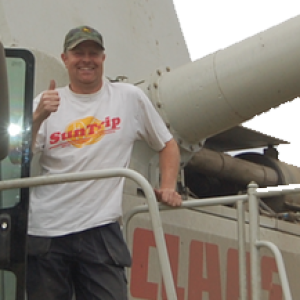
"I noticed right away during the first test that the engine responded quicker and had more pulling power. The more I’ve driven it, the more impressed I’ve become."
Carl Celsing
Owner, Rossvik Estate
Quick Overview
The Optimization and Testing
Lately, we’ve received an increasing number of inquiries about engine tuning for agricultural machinery and Construction Equipment.
Just like with cars and trucks, we can reprogram the ECU in your tractor or combine harvester to optimize engine performance.
A common question we hear is:
“Can I really save money with this kind of optimization?”
Below, our customer Carl Celsing, owner of Rossvik Estate, and his staff share their experience with two optimizations we performed—one on their combine harvester and one on their tractor.
The combine handles 7–9 tons of wheat or barley per load, bringing the total vehicle weight to around 24 tons.
How does the engine feel after the reprogramming?
– I noticed right away during the first test that it responded quicker and the machine had more pulling power.
The more I’ve driven it, the more impressed I’ve become. It runs much more easily now. When turning, reversing, or moving forward, it reacts instantly. The machine works more efficiently, and I get back to work faster. Before, it would lag, and I had to wait for it to catch up.
What does this mean for your day-to-day work?
– One important thing is that if the engine doesn’t lose RPM, there’s less crop loss.
– Now, after the optimization, the engine barely drops in RPM under load. We haven’t gone below 2000 RPM since the tuning, whereas before it would dip well below that. Just the cutting mechanism alone requires at least 100 hp from the engine, as you mentioned.
Have you been able to reduce engine load after the optimization?
– Before the optimization, we sometimes hit 100% engine load—like when harvesting winter wheat—and that didn’t feel great when running the machine 12 hours a day. If the engine dropped in RPM, we’d get crop loss because it couldn’t separate properly.”
– Now, when running with the chopper engaged, the engine load is around 30–35%. Before, it was 60–65%. We’ve never had such low engine load, no matter what type of crop we’ve been working with.
– I even tried pushing it through an unripe crop at 6.5 km/h, and the load peaked at 65%. With the stock setup, the engine would have stalled for sure. Now, the engine is no longer the limiting factor—it’s the harvester and the sorting system.
“It’s hard to say exactly how much we’re saving since it depends on the harvest from year to year, but we’re definitely saving around 20% on fuel right now.”
/Carl Celsing
Owner, Rossvik Estate
What about fuel consumption?
“The machine has two tanks – a main tank holding 750 liters and an auxiliary tank of 200 liters. Since the optimization, we haven’t needed to fill the auxiliary tank at all. Normally, the machine would go through a full tank per day, i.e. 950 liters of diesel. After just over a day’s work post-optimization, it had only used about 75% of the tank.
When Erik from OptiOne came for a follow-up visit, Jocke had been running the chopper with barley for over 9 hours and the machine hadn’t even reached half a tank yet – we could have run it a few more hours before hitting half (450 liters). That puts us close to a 50% savings.
It’s hard to say exactly how much we’re saving since harvests vary from year to year, but we’re definitely saving at least 20% on fuel right now. Let’s say we’re saving around 200–250 liters a day. That adds up to roughly 4,000 liters per season. We’ll know more precisely once the entire harvest is complete.”